My process
My work with clients is based on a simple underlying principle:
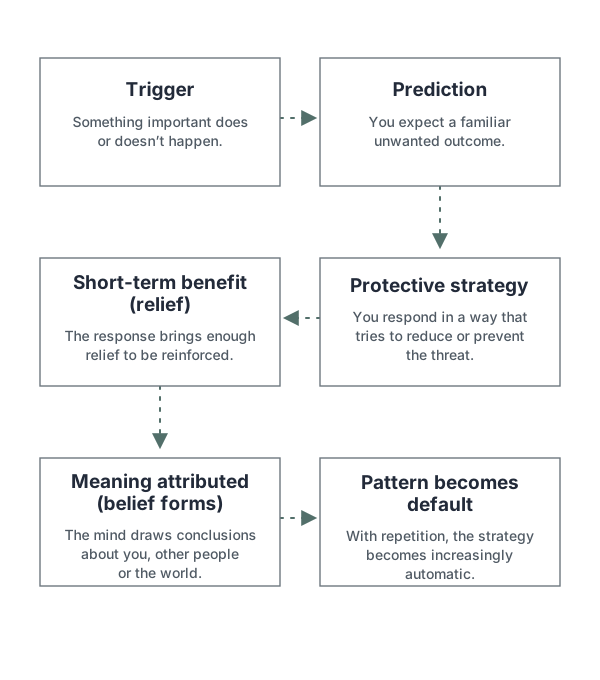
Patterns persist because earlier expectations continue to shape present behaviour.
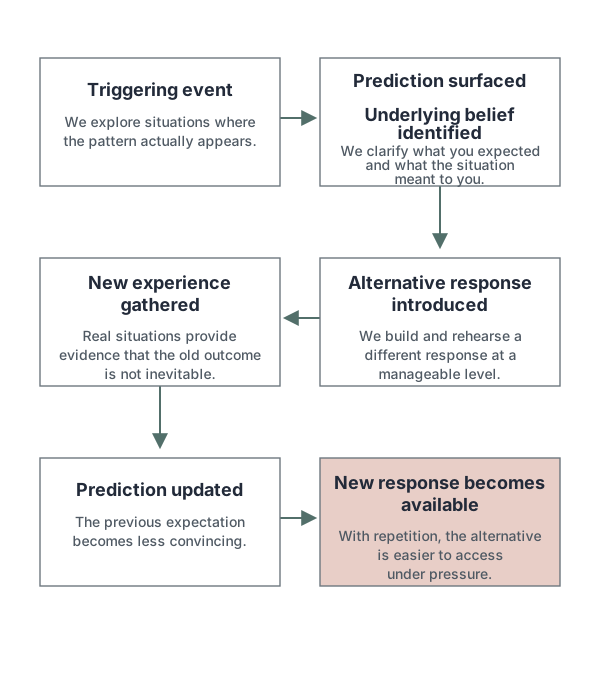
Change happens when new responses create repeated experiences that update those expectations.
Put more simply: your system is not only reacting to what is happening now.
It is also reacting to what it has learned to expect.
The process is quite simple.
In most situations the behaviour we wish to change is a response to a prediction; an expectation of what, based on previous experience, we believe will happen in a particular type of situation.
For example, we may believe that in a heated discussion our perspective won’t be heard and we’ll be forced to agree to something we don’t want. We may fear that a partner’s slow reply to a text message indicates that they’ve lost interest and are planning to leave us. We may perceive a critical comment from a boss as a sign of general dissatisfaction and ultimately as a threat to our promotion prospects, or our job security.
Often the prediction is accompanied by an underlying belief. Our minds draw conclusions from past experience to make sense of them, the ‘Why’ behind it. X happens because “I’m ‘Y’”, or because “people are ‘Z’”. In Integrated Attachment Theory these beliefs are referred to as ‘Core Wounds’. Examples are things like “I’m not good enough”, “I’m not respected”, or “People can’t be trusted”.
These beliefs often drive much of the distress that follows a triggering event, keeping it alive long after the event itself has passed.
In our work we will explore situations where these types of patterns are at play. We establish the nature of the threat that the behaviour is trying to protect you from, and any underlying belief that you are carrying with it. Repeating this process across multiple events allows us to see how your individual attachment patterns are behaving across all areas of your life.
Once we have an understanding of a pattern we can begin to change it. We start by introducing a different response, gradually at first, then build upon it until we have an alternative that can be leveraged naturally and comfortably. When the new behaviour repeatedly proves to deliver a positive outcome rather than the outcome that was feared, the old prediction weakens and the new response becomes increasingly easy to access, even in situations that would previously have been challenging.
Hand in hand with updating the behaviour, we address any associated beliefs. We provide our minds with concrete examples of alternative experiences that contradict the old belief (“core wound reprogramming” in IAT terms). With repetition, the new belief replaces the old one.